

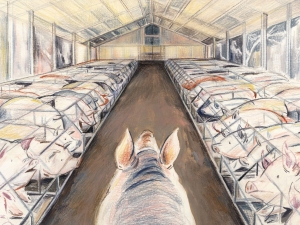
Gabriel Rosenberg, an associate professor of Gender, Sexuality & Feminist Studies and History, co-authored an article in The New Republic about the meat industry, arguing that "how Americans claim they want to treat animals and how American animals are actually treated are two very different things," as revealed by artifical insemination practices. read more » about The Meat Industry’s Bestiality Problem

Timur Kuran, professor of Economics and Political Science, joined the podcast Hidden Brain to discuss the way "our personal, professional and political lives are shaped by the fear of what other people think." Listen at the Hidden Brain website or your favorite podcast app. read more » about A Conspiracy of Silence

Rachel DuPlessis reviewed The Disappearance of Fate, a new book of poetry from Professor of the Practice of English Joseph Donahue, saying "Donahue's verse is rarely melodramatic, but rather humane and temperate, even when the insights are startling." Read the review at Hyperallergic. read more » about Poems of Spiritual Quest and Musical Yearning
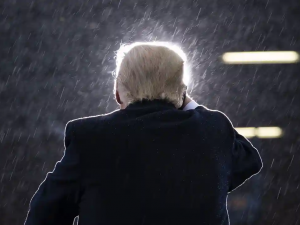
Alexander Kirshner, an associate professor of Political Science, co-authored an op-ed in the Guardian arguing that "well-designed democracies need not turn the other cheek when confronted by aspiring autocrats." read more » about Donald Trump Can – and Should – Be Stopped From Running in 2024

Samuel Daly, an assistant professor of African & African American Studies, International Comparative Studies and History, used his expertise on the history of policing in Nigeria to provide an analysis of the recent protests against the country's Special Anti-Robbery Squad (SARS). read more » about Nigerians Got Their Abusive SARS Police Force Abolished – But Elation Soon Turned to Frustration

Aleah Bowie, an associate in research in Evolutionary Anthropology, was quoted in a New York Times article about an unusual project she worked on. The animal behavior expert was emailed about "a peer-reviewed scientific paper by a team of Chinese scientists who had dedicated more than a decade to investigating why giant pandas smear their bodies with mounds and mounds of horse manure." read more » about Why Are Pandas Covering Themselves With Horse Manure?


Alexander Kirshner, an associate professor of Political Science, argued in The Hill that Donald's Trump's "refusal to acknowledge that the election has been called for Joe Biden or even to allow Biden to receive the customary security briefings given to the presidents-elect has generated broad concern about the state of our constitutional system." read more » about Saving Legitimate Opposition

Laurent Dubois, professor of Romance Studies, was quoted in a U.S. News & World Report story about the legacy of late Argentine soccer legend Diego Maradona. "I think partly there is this sense that writers and football players kind of embody the soul of nations and the Latin American continent in a way that no-one else does, certainly not political leaders," Dubois said. read more » about Maradona Mourning Shows Again Latin America's Devotion to Sport and Arts

Assistant professor of Psychology and Neuroscience Sarah Gaither appeared on Good Morning America to discuss the biracial contestants on The Bachelorette. "Watching these two people interact with each other was showing real, raw emotion about what it means to be contending with being Black and biracial in America," she said. read more » about The New ‘Bachelorette’ Gets Candid with Her Suitors

William A. Darity (Samuel DuBois Cook Distinguished Professor of Public Policy, Economics and African and African American Studies), Malachi Hacohen (Professor of History) and Adam Hollowell (Adjunct Instructor of Education) co-wrote an article for Inside Higher Ed about Duke's new inequality studies minor, arguing that students, professors and administrators need a deeper understanding of how human disparities have developed, why they persist and how they evolve over time. read more » about The Importance of Inequality Studies

James B. Duke Distinguished Professor of African & African American Studies Mark Anthony Neal wrote about Pattie LaBelle for T: The New York Times Style Magazine. Neal argued that she is the embodiment of success, the personification of warmth and an artist who changed the landscape of American music. read more » about Patti LaBelle, the Doyenne of Philadelphia Soul

Anne-Maria Makhulu, an associate professor of Cultural Anthropology, joined WUNC's The State of Things to discuss her life and career, describing her autobiographical research, her upbringing with an English mother and South African father and her time living in England, Switzerland and Botswana. Listen to the interview at the WUNC website. read more » about How Global Issues At The Dinner Table Made A Cultural Anthropologist: Meet Anne-Maria Makhulu

Kerry Haynie, an associate professor of Political Science and African & African American Studies, co-wrote an article for the Washington Post describing his new research with Beth Reingold and Kirsten Widner, which found that "women of color are the most likely to address the needs of multiple marginalized groups with their legislative portfolios, but Latinas and Black women approach such issues somewhat differently." read more » about Women of Color Won Congressional Seats in Record Numbers. How Will They Legislate?

Lillian Pierce, the Nicholas J. and Theresa M. Leonardy Professor of Mathematics, was quoted in a Quanta Magazine article about Nicolas Bourbaki, an anonymous society that has written books intended as pure expressions of mathematical thought for almost a century. Pierce describes meeting the group and explains that their anonymity is in a “spirit of fun." “There is no rigor to the secrecy,” she said. Read the article at Quanta. read more » about Inside the Secret Math Society Known Simply as Nicolas Bourbaki

Sunshine Hillygus, Professor of Political Science, was interviewed for an Atlantic article about how to convince loved ones to change their votes. “It’s not just one conversation," she said. “It is a repeated discussion of the things that you value.” Read the article at The Atlantic. read more » about The Science of Changing a Loved One’s Vote


Writing at Foreign Policy, Professor of Political Science Peter Feaver argues that the presidential election "was no repudiation of Trumpism, making it harder for the [Republican] party to heal and return to its strengths." Instead, Feaver claims, "the Trumpist faction in the party will be empowered and in no mood to compromise or reform." read more » about What Trump’s Near-Victory Means for Republican Foreign Policy

Research by Professor of Sociology Mark Chaves provides the foundation for this New York Times article about how conservative churches engage in politics, even though pastors can’t endorse or oppose candidates from the pulpit. read more » about Preaching or Avoiding Politics, Conservative Churches Walk a Delicate Line

NetIndian profiles a new book by Sumathi Ramaswamy, James B. Duke Distinguished Professor of History and International Comparative Studies, in which the historian examines art that depicts Mahatma Ghandi. Read the article at NetIndian. read more » about Gandhi in the Gallery: The Art Of Disobedience

Gabriel Rosenberg, Associate Professor of Gender, Sexuality and Feminist Studies, co-authored an essay at The New Republic arguing that en vogue bioengineering solutions to the climate issues with meat consumption are doomed to fail, and the only real solution is to eat less meat. read more » about Instead of Reengineering Cows, Just Eat Less Meat

Kathy Rudy, Professor of Gender, Sexuality & Feminist Studies, wrote an op-ed for Religion News Service arguing that Amy Coney Barrett's Catholicism closely follows the rulings from the governing body of the Roman Catholic Church, even though those teachings are at odds with most Americans' beliefs—including pro-life Americans. read more » about Barrett’s Faith Views Go Beyond Even Many Pro-life Americans’ Beliefs

Drawing on the National Congregations Study led by Professor of Sociology Mark Chaves, this New York Times article covers eight churchs that closed before reopening as different kinds of buildings and instutions, including a cafe, a music studio, and an internet archive. read more » about New Spirits Rise in Old, Repurposed Churches

Beverly McIver, Professor of the Practice of Art, Art History & Visual Studies, is profiled in this article at O'Henry Magazine. read more » about The Light Within

Sandy Darity, Samuel DuBois Cook Distinguished Professor of Public Policy, African & African American Studies and Economics, explains his research on reparations in this article at GQ. read more » about How Much Is Owed to Afro-descendants in the Americas?

Deborah Jenson, Professor of Romance Studies, explains the role played by Dr. Jean-Jacques Muyembe-Tamfum in finding treatments for Ebola. Read the article at STAT. read more » about Thank This Ebola-fighting African Doctor for Monoclonal Antibody Treatments

Christopher Johnston, Associate Professor of Political Science, co-authored an op-ed in the Washington Post about the research in his book Curbing the Court: Why the Public Constrains Judicial Independence. In it, he argues that the American public is "less willing to defend the Supreme Court’s stability and integrity than many political scientists believe — especially now, at a time when they’re so polarized ideologically." read more » about Why Americans are Perfectly Willing to Undermine the Integrity and Independence of the Supreme Court

Kerry Haynie, an Associate Professor of Political Science, participated in a panel about political engagement, offering his take on which states will have the highest turnout, the impact of political action committees and more. Read the article at WalletHub. read more » about 2020's Most & Least Politically Engaged States

Brian Hare, professor of Evolutionary Anthropology, and Vanessa Woods, a research scientist in the same department, are interviewed about their book Survival of the Friendliest in this video by National Geographic. read more » about Why It Actually Might Be 'Survival of the Friendliest'

Jonathan Mattingly, James B. Duke Distinguished Professor of Mathematics, was interviewed on the mathematics of gerrymandering and the way computer generated maps can detect the problem. Read the article at Science News. read more » about How Next-gen Computer Generated Maps Detect Partisan Gerrymandering