


Psychology & Neuroscience Professor Greg Samanez-Larkin and colleagues Daisy Burr, Jaime Castrellon, and David Zald share their findings in an article discussing the advanced ages of the U.S. President candidates. They found evidence that older adults are better at keeping their emotions and impulses in check. Read more in The Atlantic. read more » about The Upside to Having an Old President

In an article discussing how psychological research focuses heavily on people in U.S. and other affluent Western countries, Psychologist Sarah Gaither discusses her study of identity, including how people conceptualize racial categories. Much of her work focuses on biracial children, a group that is often shunted into one racial category, or simply excluded from studies altogether. Read more in the Atlantic. read more » about The Problem That Psychology Can’t Shake

Trinity Professor Priscilla Wald discusses the Coronavirus outbreak, how the Declaration of Alma-Ata comes into play, and the impact of a universal access to health care. Read more in the Charlotte Observer. read more » about The best way to prevent an outbreak like Coronavirus

Asian and Middle Eastern Studies Professor Mbaye Lo spoke at Duke's Black Muslim Atlantic Symposium at Duke University, discussing the conflicting narratives about Omar ibn Said, a black Muslim scholar captured in Senegal in 1807 and transported by boat to Charleston, S.C. Lo said scholars have underestimated Said's intellectual and scholarly training and his ability to use that training to compose something that had significant meaning. Read more in Religion News. read more » about New research reconsiders writings of a Muslim slave and scholar

An exhibit at Duke's Fredric Jameson Gallery focuses on Central American representation and was spurred by an idea from Claudia Milian, who leads Duke's Program in Latino/a Studies in the Global South. The story behind this exhibit is spotlighted in Remezcla. read more » about ‘Connected Diaspora’ Exhibition Aims to Boost Central American Representation in the US Art World

Brian Hare, professor of evolutionary anthropology and researcher/founder of the Duke Canine Cognition Center, was quoted in a article comparing language skills in children and dogs. Read the full article in The Washington Post. read more » about Babies are bad at listening in noisy places. Dogs aren’t. My pets took part in a study to learn why.

A profile of Duke mathematician Ingrid Daubechies was published in the Wall Street Journal. read more » about Mathematics Pioneer Ingrid Daubechies Has More Barriers to Break

A startling experimental discovery about how fluids behave started a wave of important mathematical proofs. Duke mathematician Alexander Kiselev comments in the article in Quanta Magazine. read more » about For Fluid Equations, a Steady Flow of Progress
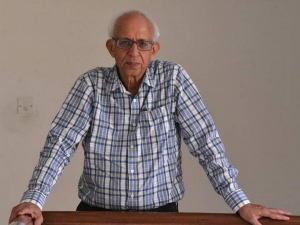
Asian & Middle Eastern Studies Professor Satti Khanna discusses translating works from poet and novelist Vinod Kumar Shukla. Read the full article in The Hindu. read more » about Satti Khanna and the art of translation

Photographer Alex Harris, from Duke's Center for Documentary Studies, grapples with the interplay between production sets and physical locations in his recent project, "Our Strange New Land," which is on display at Atlanta's High Museum of Art. Read more in the The New Yorker. read more » about Finding Truth and Fiction on Film Sets in the South

Higher education institutions like Duke are gateways to opportunity and success for many low-income and first-generation college students. They are also home to professors who once stood in those students’ shoes and used their education to get into academia. Here are some professors from Duke who were low-income, first-generation (LIFE) college students. Jen’nan Read: Sally Dalton Robinson professor of sociology, chair of the department of sociology Jen’nan Read was born in the United States and moved to… read more » about Professors from low-income first-generation backgrounds are ready to help Duke students

Exhibition organized by Dance professor Thomas F. DeFrantz runs through January at Seattle's Frye Art Museum. The show traces the evolution, over 40 years, of choreographer Donald Byrd’s commitment to dance as a catalyst for social justice. Read more about the exhibition in the New York Times. read more » about Can Dance Make a More Just America? Donald Byrd Is Working on It


Deborah Reisinger, Romance Studies professor and director of Cultures and Languages Across the Curriculum at Duke, discusses students using a second language in their studies. Read the full article in the Washington Post. read more » about What happens when college students discuss lab work in Spanish, philosophy in Chinese or opera in Italian?

Cave Canem, a national organization committed to cultivating the artistic and professional growth of Black poets, speaks with Duke's Tsitsi Ella Jaji, winner of the Cave Canem Northwestern University Press Poetry Prize for a second-book and author of Mother Tongues. Read the full interview In Pen America. read more » about The PEN Ten: An Interview with Poet Tsitsi Ella Jaji

Duke Political Science Professor Ashley Jardina's study discussed in article regarding race and the 2016 presidential election. Read the full article on Foreign Affairs. read more » about What Is White America?

A recent paper by Mathematics professor Jonathan A. Campbell and Cornell University's Inna Zakharevich made a significant advance on the topic of "scissors congruence." Even more significantly, their approach tied that problem to a related one in algebraic equations, offering new insight into the fundamental questions at play. Read more about their work at Quanta Magazine. read more » about Mathematicians Cut Apart Shapes to Find Pieces of Equations

History Professor Sumathi Ramaswamy discusses Gandhi's role in India's visual culture. Read the full story in the New York Times. read more » about The Many Faces of Gandhi

Duke historian James Chappel's book, Catholic Modern: The Challenge of Totalitarianism and the Remaking of the Church, is discussed in Princeton professor's article regarding the catholic church and Pope Francis. Read the full article at The Nation. read more » about The Two Catholicisms: The church between tradition and modernity.

Associate Professor of Economics Erica Field and a colleague from Yale discuss a series of experiments in India that provide insights into ways microfinance can be refined to strengthen its impact for the world’s poorest women. Read the full article on VoxDev. read more » about Give women credit
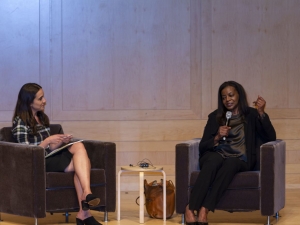
History and African & African American Studies Professor Thavolia Glymph led a discussion for Philadelphia Municipal Court judges and other court employees regarding an 1857 U.S. Supreme Court decision on rights of black people. Read the full article in the Philadelphia Inquirer. read more » about Philadelphia judges find modern meaning in the 1857 Dred Scott case

Paper co-authored by Economics Professor Francesco Bianchi discusses how President Trump's comments impact the Federal Reserve's credibility with investors. Read the full article in Forbes. read more » about How Trump's Tweets Killed The Fed's Credibility

Political Science Professor Michael Munger discusses the California bill that distinguishes between contractors and employees. Read his full article on The Hill. read more » about Michael Munger: Distinguishing contractors from employees

Senior Lecturer of Cultural Anthropology Robin Kirk discusses the aftermath when a Confederate statue was toppled in Durham, N.C. Read her full article in the American Scholar. read more » about Reflections on a Silent Soldier

The work of James B. Duke Professor of Mathematics Jonathan Mattingly appeared in numerous media outlets this fall — including this News & Observer article — following the N.C. Supreme Court's decision that political maps for the state were unconstitutional and must be redrawn. Mattingly, who testified as an expert witness in the case, leads a nonpartisan research group "Quantifying Gerrymandering" that grew out of a project initiated by a Duke mathematics undergrad. read more » about Mathematician's research influences NC ruling

Political Science Professor Eddy Malesky and a lecturer from the Australian National University surveyed people in Vietnam to see if those in developing countries prioritize the economy or the environment. Listen to the results during their podcast on Rocking Our Priors. read more » about "Fish or Steel?": Dr Quynh Nguyen & Professor Eddy Malesky
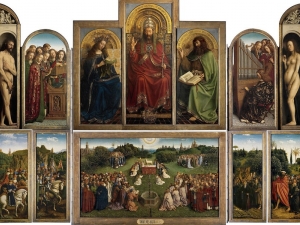
Duke University participates in team using artificial intelligence to study the masterpiece, The Adoration of the Mystic Lamb. Read how this technology differs from the previous X-ray process in Cosmos. read more » about AI reveals the hidden layers of great art

Duke evolutionary geneticist John Willis examines the monkeyflower mystery and shares his findings in Science magazine. read more » about Meet the monkeyflower, a weed that may hold the key to zebra stripes and other biological mysteries

Duke Economist Professor Timur Kuran discusses his theory of Preference Falsification — which explains the world wide surge toward populism and is now threatening to rewrite the core tenets of modern ecomomics — in a podcast on The Portal. read more » about Timur Kuran: The Economics of Revolution and Mass Deception
